Mital Patel
1. Congratulations on winning in the London Photography Awards! Can you share a little about yourself, what inspired you to pursue photography, and how has your journey evolved since your first shot?
Thank you! I started photography after receiving my first camera at age 12 to take on a trip to Asia. That was my first moment feeling empowered to capture moments of family and travel. Over time, I became the family’s de facto photographer; I felt this quiet obligation to preserve memories for everyone.
As the years went on, I kept shooting, gradually refining my craft into what it is today. My first shots were full of classic rookie mistakes; for example, underexposed portraits where I exposed for the background instead of the faces. Those trials and errors were essential to learning how to use the camera.
From those early-day photographs to today, my photography has evolved to be more purposeful: telling stories, raising awareness, and serving as a vehicle for conversation.
2. Can you share the story or inspiration behind your award-winning piece? How does winning this award make you feel about your journey in photography?
This series of photos was taken over the course of eight years, documenting different volcanoes and lava flows. One of the most memorable moments was seeing the lava flow into the ocean, creating a massive plume of steam under the starry sky. That photograph was taken in Hawaii, after a two-hour hike through the dark, dried lava fields. It was definitely a moment I’ll never forget.
I wasn’t expecting to win. There were many talented photographers who submitted, so I’m honoured to be in their company and to have received this award. Winning reinforces that my work has meaning and encourages me to keep bringing important stories to light and to create greater good through this medium.
3. How do you decide which photo to submit for a competition?
It was a tough decision. I had several series to choose from; however, I felt I hadn't seen a good, cohesive set of volcanic images entered into competitions. I thought the contrast between volcanoes, water and ice gave this body of work a unique conceptual focus and a sense of unity.
4. What first made you pick up a camera?
Curiosity. Novelty. Scarcity. We had one camera in my family, and whenever I had the opportunity to take a few pictures, I was hooked. I’ve brought a camera on trips since I was 12, and I’ve been able to capture wonderful memories.
5. What’s your favorite type of photography, and why do you love it?
I tend to think that favourites evolve as we mature and gain new inspiration. At this moment, my favourite type of photography is wildlife. I love bringing animals into the spotlight as if they’re human models, and giving them the same level of emotional connection we usually reserve for people. I especially love it because it allows me to tie my work into wildlife conservation.
6. What’s your go-to camera setup, and why does it work best for your projects? What’s your favorite feature?
It depends on the shoot. For wildlife photography, I carry three camera bodies, each mounted with a different lens. This setup gives me access to a full range of focal lengths, so I can stay present with the animals and not have to fumble with gear.
One of my favourite features of the camera is being able to set the shutter to “silent.” When that’s activated, there’s no intrusive shutter sound, no distractions—just the ability to fully hear and appreciate all of the wonderful sounds in nature.
7. If someone looked at your work, what’s the one thing you’d want them to feel?
I want them to feel a sense of responsibility—the responsibility to protect nature, to help protect wildlife from becoming endangered, to raise awareness, to start conversations, and to share the message. I want them to feel connected to the photographs, to feel that we are one.
8. What was the most challenging part of capturing your winning shot?
The journey itself is often the greatest challenge—the logistics it takes to reach and photograph these incredible places. Flying to Iceland and hiking four hours in the snow to reach the volcano. Hiring a helicopter to fly over Kilauea and travelling up a 12,000-foot dormant volcano to photograph the neighbouring Fuego Volcano.
9. Is there a specific place or subject that inspires you the most?
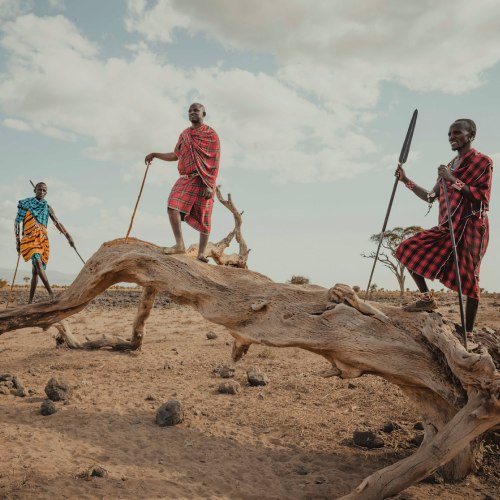
Right now, it's Africa: the people, the culture, and the animals. It’s the fuel for my soul.
10. Who or what has been your biggest influence in photography?
I would say it's a collective—I’ve learned from many different photographers, gaining insight into technique, storytelling, and advocacy, to name a few. However, one of my biggest influences has been one of my best friends, Mike Mezuell II. I began my professional journey with him, travelling the world together and sharing unforgettable experiences.
11. What message would you share to inspire photographers to participate in photography awards, and what advice would you give to help them excel in the competition?
Don’t give up. Participate. Lead with your passion and what brings you happiness. Do it for yourself, not for others.
12. What’s one piece of advice for someone just starting in photography?
Absorb everything you can, and over time, you’ll naturally find your path as you fine-tune what you love to shoot.
13. What role do editing and post-processing play in your creative workflow?
I am not a photojournalist—my objective is to share images that evoke emotions, reduce the noise, and guide the viewer into the heart of the action. Through editing and post-processing, I shape the narrative and lead the viewer’s eye through the image.
14. How do you see technology, like AI, influencing the future of photography and your own approach?
It’s scary how quickly it has evolved. AI-generated images have been entering the commercial space and even the fine art space with digital NFTs. The key difference between human-made and AI-generated photography will always be the story and soul behind the image—something that technology can’t replicate.
15. If you could photograph anything or anyone in the world, what would it be?
Panda bears. They're elusive, rare, and endangered. Photographing them would be both a privilege and a challenge, and I’d love to help tell their story.